LATEST TECHNOLOGY NEWS | GADGET REVIEWS | SOCIAL MEDIA UPDATES | INFORMATION TECHNOLOGY NEWS | MOBILE WORLD | CAR WORLD | NATIONAL-INTERNATIONAL NEWS AND MANY MORE..........

Pages

Translate My Page

Wednesday, October 24, 2012

Samsung launches 75ES9000, 75-inch LED Smart TV;

The ES9000 will be sold for US$9,999 when it arrives in U.S. stores next month (ES8000 pic...


Samsung has announced the launch of its 75ES9000 LED Smart TV in India priced at Rs. 7,50,000. The Smart TV is available at select Samsung authorised outlets across the country.

The ES9000 Smart TV sports a huge 75-inch screen and a rose-gold-coloured finish. It has a slim 7.9mm curved bezel and features a built-in camera. The TV is powered by a dual-core processor that facilitates multitasking.

The high-end television boasts features like Smart Interaction that allows users to control the television using gestures, Smart Content that provides a range of premium
Samsungoptimised content, and Smart Evolution technology that promises painless-software upgrades to ensure your TV stays "up-to-date".

Speaking of gesture control, the Korean giant has released the Angry Birds app as part of its Smart Interaction feature. Users can experience gameplay by waving their hands to fling the birds and equip them with their unique powers. Angry Birds will be available as a free download on
Samsung's ES7500, ES8000 LED, ES9000 LED TVs and E8000 Plasma TVs.

The Smart TV also includes Sound Share, a new feature, which automatically and wirelessly connects the TV audio to Samsung's Series 6 and Series 7 Wireless Audio with Dock Systems.

Speaking at the launch, Mahesh Krishnan, Vice President, Consumer Electronics,
Samsung India said, "The ES 9000 represents superior quality, best in class performance and features in a very sophisticated and elegant design. It provides consumers with a pure immersive viewing experience.

The ES9000's utilises
Samsung's Micro Dimming Ultimate and Precision Black technology to deliver improved picture quality. Samsung claims that the pictures scan now be viewed in greater detail, higher contrast ratios and with a 30 percent improvement in sharpness and black levels. The company also says that there's a 60 percent improvement in brightness levels over the ES8000 series, supporting larger screen sizes and longer viewing distances.
Samsung also officially unveiled special Diwali offers for Indian consumers. Users purchasing a Samsung Smart LED or Plasma TV models in Series 7 and 8 of 46-inches and above, will be entitled to a Galaxy Tab 310 and an 11 by 1 easy consumer finance scheme. Those buying a Samsung 3D TV model from LED Series 6 or a Plasma Series 5 will get a 3D BD Player along with 3D Movie titles worth Rs 10,990.

Buyers of LED TV Series 5 will get a free Skype camera and Wi-Fi dongle. Purchase of all 32-inch and above Panel TVs and any
Samsung Home Theatre System, will offer consumers a free 51 Movie DVD pack. Purchase of any Samsung Home Theatre System will additionally assure a saving of up to Rs 10,000. 

Exclusive Video of Samsung ES9000 for pramodtechnoblog fans:


Tuesday, October 23, 2012

YouTube plans paid video service in India

http://www.gizbot.com/files/2012/10/Youtube-partner-Pay-Per-View-Video-Service.jpg

Google’s YouTube video-sharing website may soon offer pay-per-view services for its Indian viewers, a move that could help the movie industry fend off growing piracy concerns while expanding the range of viewing options for customers. 

Over the past two years, YouTube has started introducing paid video in different countries with Google having introduced its pay-per-view services in Australia, Korea and Japan over the last six months“

Our pay-per-view services or ‘rental’ model is a natural step here in India for the partners that we are working with. For instance, Eros Entertainment who has been with us for a long time already has a lot of content up on YouTube. 

“Once we have the functionality in, it will be done. There are many Indian media companies which are interested,” said Gautam Anand, Director, Content Partnerships, Google Asia Pacific. 

Rental model
 
In the ‘rental’ model, viewers will be able to pay a one-time fee to stream the movie for a limited amount of time. 

Pointing out that it was not a question of conducting talks, he said: “The major roadblock, which we are working on, is the payment mechanism – enabling carrier billing for example. We want to be able to ensure a seamless experience. Once this is done it will happen.” 

Regional Content

Gautam Anand
Gautam Anand
According to Mr. Anand, regional television has the potential to be converted into YouTube content. At present, close to 30 per cent of television broadcast are in regional languages. 

“We are raising a lot of awareness through our YouTube Partner Program on how regional content producers in South India can make money by putting up their videos on our website. We have seen its potential, much of this type of content is popular aboard,” he said. 

In YouTube’s Partner Program, the content producer’s videos are packaged along with advertisements and then hosted. The revenue generated is then split between the partner and Google. At present, YouTube’s India partner plan has over 1000 participants.

BlackBerry app-coding marathon

BlackBerry JamHack, a marathon hacking event, is scheduled to take place in 10 different cities across the Asia-Pacific over two consecutive weekends. Winning teams from each city will then have the opportunity to represent their country at the JamHack finals at BlackBerry Jam Asia on November 29 and 30, a release from Research in Motion stated. 

This weekend, it is being held simultaneously in Bangalore, Delhi, Kuala Lumpur, Singapore and Manila. The event will be held in five other cities over the next weekend. The event will be held over 40 hours and teams of four, comprising developers, User Interface designers and marketers will work on apps, with support from RIM’s developer relations team. On the itinerary are “community sharing” sessions called JamBytes, the release added. 

For details, visit www.blackberryjamhack.com

Virtual bookstore from BookAdda.com

http://images.abc-directory.com/4629695-2.png
 
BookAdda.com — India’s largest online retailer of books has announced a fresh initiative that furthers the company’s vision of making education books accessible in the country. The company’s latest product offering — Acadzone.com — has been envisioned as a one-stop-solution for all academic and competition books. 

Acadzone.com is India’s largest online bookstore for students and houses over one crore titles. The website’s user-friendly interface allows a single-click buy for all curriculum course books. The books range from university textbooks, job vacancies and test preparations like UPSC, banking & finance, engineering, law, MBA and medical. Apart from buying new books, students also have the option of buying and selling their old textbooks through an exclusive Facebook App. This makes it the first such app in India that allows students to network and trade in used books. 

Innovative
 
The website facilitates a wide variety of innovative buying options for the students including group buying deal programme which is a simple way for students to come together, where they can create, customize deals and invite their peers and save an additional 5 per cent on their book purchases. 

One click buy for all course books is a syllabi-based site across all the courses for 15 plus universities, covering more than 2,000 colleges across India. 
 
The website has already mapped more than 20 leading universities in India and will offer curriculum books catering to the wider student community of over 2,000 colleges under these universities. This will help them with ease of search and allow them to buy their college books in one click. 

Exclusive App
 
BookAdda has also been selected by Microsoft to launch an exclusive Acadzone app which will be available on the upcoming Windows 8 platform. Available on computers and laptops, the app will enable students to buy books and even resell old ones. With these initiatives, Acadzone aims to make education more interactive by bringing students together. 

Hemant Kohli, CEO & Co-Founder, Bookadda.com, says “Although there has been mushrooming of many online book retailers, there was still a big gap when it came to the availability of academic books,’’ he said adding Acadzone.com was the first step towards bridging that gap and the website will offer the most comprehensive collection of books related to different curriculum. 

Bookadda.com was conceptualised in 2010 by Arjun Kumar and Mahipal Reddy, and is led by Hemant Kohli.
AcadZone.com offers students a single-click buy for all curriculum course books, a one-stop destination for various competitive exam books and money-saving group buying facility.

India-Japan cyber security meet on November 5

http://www.madhyamam.com/en/sites/default/files/imagecache/w604/India%20-%20jappan.jpg
 
India and Japan will hold their maiden dialogue on cyber security on November 5, it was decided at their “2+2” meeting in Tokyo on Monday.

The four-hour meeting of the 2+2 or Foreign and Defence Secretaries from both sides, a format rarely used by New Delhi, also took some decisions to advance defence and security cooperation. 

Officials, however, were tight-lipped as the proposals will be fine-tuned and unveiled during next month’s summit meeting between Prime Minister Manmohan Singh and his Japanese counterpart Yoshihiko Noda.

The Indian team for the cyber security dialogue will be led by Ministry of External Affairs Special Secretary Ashok Mukherjee. 

Officials hope that the exchange of notes on the topic with a developed country would help hone up security of the Indian cyber network, which faces relentless attacks from hackers based here and abroad.

“We hope to learn from them as we go about protecting ourselves from cyber attacks,” said an official source. 

The two delegations also exchanged views on maritime and outer space security.

Foreign Secretary Ranjan Mathai, who participated in the dialogue along with Defence Secretary Shashikant Sharma, later called on Japanese Foreign Minister Koichiro Gemba.

The second 2 + 2 dialogue began with an assessment by the former Ambassador to India and Deputy Foreign Minister, Akitaka Saiki, about the security environment around Japan. 

This was followed by Mr. Mathai detailing India’s perception of the security environment from the Gulf to South East Asia and beyond. Administrative Vice Defence Minister Hironori Kanazawa then provided an overview of how Japan intends to adjust its security policy to the prevailing environment.

How many mobile operating systems are there? (Campus Essentials)


http://sparklingspur.com/wp-content/uploads/2011/07/Mobile-OS-list-of-all.jpg

Mobile operating system


A mobile operating system, also referred to as mobile OS, is the operating system that operates a smartphone, tablet, PDA, or other digital mobile devices. Modern mobile operating systems combine the features of a personal computer operating system with touchscreen, cellular, Bluetooth, WiFi, GPS mobile navigation, camera, video camera, speech recognition, voice recorder, music player, Near field communication, personal digital assistant (PDA), and other features.


Mobile Operating Systems

Not sure what a smartphone mobile phone operating system is, or why you might need one? Unclear on what mobile operating systems are available and which one is most suitable for you? Read our guide below to find out. 

What is a mobile phone operating system?


Long gone are the days when mobile phones were just a device to make phone calls and occasional texts. Now they are handheld computers, where we can send emails, play games, watch the news and make video calls to loved ones. More commonly, these are known as 'smartphones'.

We have operating systems to run our desktop computers and laptops, and smartphones use them too, to introduce advanced functions to a mobile phone that were only available on our computers before. 

Functionality is a big selling point for the smartphone - there were more than 400 million smartphone worldwide and it's their operating systems that define what functions they can carry out and how the phone manages its memory.
It is also a platform so developers can create applications or 'apps' (software programs developed for smartphones that can carry out specific functions).

There are hundreds of thousands of apps available and they are constantly being developed - each with their own purpose. For instance, you may download a weather app that tells you the current temperature or chances of rain in your city, a news app or widget that sends the latest headlines straight to your device's homescreen, or a game to simply pass the time.


How do I know what operating system my mobile phone has?


Because operating systems are so integrated with the look, feel and function of a mobile phone, many people base their choice of device around which operating system it uses.

If you have already bought your smartphone, the name and version of its software should be detailed in the settings menu. However, if you are buying a new phone, the operating system can be found the handset's specifications information.

What different kinds of smartphone operating systems are there?


Some are open source software, which means there are no restrictions on what you can download on it, or who can develop its software (there are often a 'community' of developers) - it is entirely customisable, whilst others are restricted in the types of software permitted to run on the device.

Some of the best-known mobile operating systems include:

iOS


The Apple iOS multi-touch, multi-tasking operating system is what runs the Apple's iPhone, iPad, and iPod Touch.

It responds to the user's touch - allowing you to tap on the screen to open a program, pinch your fingers together to minimise or enlarge an image, or swipe your finger across the screen to change pages.

The Apple iOS is not allowed to be used in third party systems, so you will only be able to use it on products made by Apple. It comes with the Safari web browser for internet use, an iPod application for playing music and Apple's Mail for managing your missives.

You can download more than 500,000 applications currently available on the App Store directly to any device running iOS, be it an iPhone or an iPad. These encompass everything from accessing recipes to playing the guitar or working on your documents on the move.

Android


Android OS is owned by Google and powered by the Linux kernel, which can be found on a wide range of devices. 

Android is an open source operating system which allows developers to access unlocked hardware and develop new programs as they wish.

This means unlimited access to any anyone who wants to develop apps for the phone and places very little restriction on its licensing, so users benefit from a tonne of free content.

Android is currently the fastest growing smartphone operating system in the market and is expected to become the dominant platform in a few years due to its tremendous traction with a wide spectrum of users.

Some of the best features of Android include the ability to customise multiple homescreens with useful widgets and apps that give you quicker, easier access to the content and functions you most care about. It also has an excellent capacity for multitasking - with the ability to close programs simply swiping them away. 

Last but not least, the Android Market, which is the Android equivalent of the Apple App Store is home to more than 370,000 apps, many of which are completely free.

Windows Phone 


Microsoft released its latest version of the Windows platform for mobiles in late 2010, which has been redesigned and rebuilt from the ground up with a greater emphasis on the user experience. It is recognisable by its tile-based interface - dubbed Metro - which features removable and interchangeable squares sections on the home screen, each with its own purpose and function.

It also has aggregators called 'hubs', that group together all photos from all applications, or all music into one library, meaning your Facebook photos can be found with your camera photos and your documents from different sources grouped together in one, easy to access location.

Windows Phone comes with a mobile-optimised version of the Internet Explorer for accessing the web, and Exchange, which supports secure corporate e-mail accounts with push support.

Symbian OS from Nokia and Accenture


Symbian is Nokia's own operating system and is now mainly used on mid to low-end handsets since Nokia announced it would be migrating its flagship efforts to Microsoft's Windows Phone operating system.

Symbian's strength is in bringing smartphone functionality - including e-mail, apps and multitasking - to handsets at the lower end of the market and in emerging markets.

Like most smartphone operating systems, you can download apps on a Symbian device and customise it to your liking with widgets and shortcuts. You can also get free maps and turn by turn navigation from Nokia and other useful tools installed out of the box, such as a document viewing and editing suite.

bada from Samsung Electronics 
 

This is a mobile operating system being developed by Samsung Electronics. Samsung claims that bada will rapidly replace its proprietary feature phone platform, converting feature phones to smartphones.The name 'bada' is derived from 바다, the Korean word for ocean or sea. The first device to run bada is called 'Wave' and was unveiled to the public at Mobile World Congress 2010. The Wave is a fully touchscreen running the new mobile operating system. With the phone, Samsung also released an app store, called Samsung Apps, to the public. It has close to 3000 mobile applications. 

 
Samsung has said that they don't see Bada as a smartphone operating system, but as an OS with a kernel configurable architecture, which allows the use of either a proprietary real-time operating system, or the Linux kernel. Though Samsung plans to install bada on many phones, the company still has a large lineup of Android phones.
 
BlackBerry OS from RIM
 
This OS is focused on easy operation and was originally designed for business. Recently it has seen a surge in third-party applications and has been improved to offer full multimedia support. Currently Blackberry's App World has over 50,000 downloadable applications. RIM's future strategy will focus on the newly acquired QNX, having already launched the BlackBerry PlayBook tablet running a version of QNX and expecting the first QNX smartphones in early 2012.
 
Palm OS/Garnet OS from Access Co. 
 
webOS was introduced by Palm in January 2009 as the successor to Palm OS with Web 2.0 technologies, open architecture, and multitasking capabilities.
 
Brew from Qualcomm 
 
Brew is used by some mobile phone manufacturers and mobile networks, however most often the end-user does not know this since mobile phones running Brew most often lack any Brew branding. Brew runs in the background with the custom "skins" of the mobile phone manufacturer or operator on-top. Brew is used by Sprint Nextel, metroPCS, U.S. Cellular and Verizon in the US and by the Three network in much of Europe, the UK and Australia on many mobile phones produced especially for their network. Manufacturers such as LG CDMA, Huawei, INQ Mobile, Amoi, and Samsung Mobile amongst others use Brew in some of their mobile phones and it is featured in Three UK phones such as the 3 Skypephone, INQ1 and Huawei u7510 (3 Touch). Two of HTC's mobile phones use Brew's successor Brew MP.
 
 
MeeGo from non-profit organization The Linux Foundation (open source, GPL)
 
At the 2010 Mobile World Congress in Barcelona, Nokia and Intel both unveiled 'MeeGo' a brand new mobile operating system which would combine the best of Moblin and the best of Maemo to create a truly open-sourced experience for users across all devices. As of 2011, Nokia has announced that it will no longer be pursuing MeeGo and will instead adopt Windows Phone as its primary mobile OS. Nokia announced the Nokia N9 on June 21, 2011 at the Nokia Connection event in Singapore. The phone is presumed to become available to the public in September 2011. LG announced its support for the platform.
 
Maemo from Nokia (open source, GPL)
 
Maemo is a software platform developed by Nokia for smartphones and Internet tablets. It is based on the Debian operating system. 
 
Maemo is mostly based on open source code, and has been developed by Maemo Devices within Nokia in collaboration with many open source projects such as the Linux kernel, Debian and GNOME. 
 
Maemo is based on Debian GNU/Linux and draws much of its GUI, frameworks and libraries from the GNOME project. It uses the Matchbox window manager and the GTK-based Hildon as its GUI and application framework.
 
Nucleus from Mentor Graphics 
 
Nucleus OS is a real-time operating system (RTOS) and toolset created by the Embedded Systems Division of Mentor Graphics for various central processing unit (CPU) platforms. The Nucleus RTOS is designed for embedded systems applications including consumer electronics, set-top boxes, cellular phones, and other portable and handheld devices. For limited memory systems Nucleus RTOS can be scaled down to a memory footprint as small as 13 KB for both code and data. Manufacturers such as Motorola, Samsung, LG, Siemens/Benq, Sagem, Pantech, and NEC use Nucleus in some of their mobile phones. The last devices released that used Nucleus OS are LG Encore (GT550), LG Prime (GS390), and Pantech Pursuit (P9020).
 
Some of the expected mobile operating systems in future

Aliyun OS from Alibaba/AliCloud (cloud based) 
 
AliCloud's operating system revolves around the idea of bringing cloud functionality to the mobile platform. According to the company, Aliyun will feature cloud-based e-mail, Web search, weather updates, and GPS navigation tools. In addition, the operating system will synchronize and store call data, text messages, and photos in the cloud for access across other devices, including PCs. Alibaba says it will offer customers 100GB of storage at launch. the operating system would allow users to access applications from the Web, rather than download apps to their devices.
BlackBerry 10 from RIM 
 
BlackBerry 10 (previously BlackBerry BBX) the next generation platform for BlackBerry smartphones and tablets. In other words, there will be only one OS for both Blackberry smartphones and tablets going forward.
Firefox OS from non-profit organization Mozilla Foundation
 
According to Ars Technica, "Mozilla says that B2G is motivated by a desire to demonstrate that the standards-based open Web has the potential to be a competitive alternative to the existing single-vendor application development stacks offered by the dominant mobile operating systems."
Tizen from non-profit organization The Linux Foundation
 
Tizen is an open source project hosted by the Linux Foundation, with Intel and Samsung leading its development steering group, and support from the LiMo Foundation. According to Intel, Tizen “combines the best of LiMo and MeeGo." HTML5 apps will be emphasized for the new OS, with the MeeGo project encouraging its members to transition to Tizen, stating that the "future belongs to HTML5-based applications, outside of a relatively small percentage of apps, and we are firmly convinced that our investment needs to shift toward HTML5." Tizen will be targeted at a variety of platforms such as handsets, tablets, smart TVs and in-vehicle entertainment. The initial release of Tizen is targeted for Q1 2012, with the first devices using the OS planned to reach the market in mid 2012.
Windows 8 from Microsoft
 
Microsoft announced that Windows 8 will support tablet devices as well as PCs.
 
Windows RT from Microsoft 
 
Microsoft announced Windows RT. an OS design for only tablets and can only run on arm. This version also resembles windows 8. Windows RT cannot run x86 programs. Apps can be only downloaded from the windows store. This version also has Microsoft office 2013 preinstalled on every Windows RT device.
 

Monday, October 22, 2012

What is Fat (Thick) client? (Campus Essential) - Exclusive Post of the day for IT Students


Thick clients, also called heavy clients, are full-featured computers that are connected to a network. Unlike thin clients, which lack hard drives and other features, thick clients are functional whether they are connected to a network or not.

While a thick client is fully functional without a network connection, it is only a "client" when it is connected to a server. The server may provide the thick client with programs and files that are not stored on the local machine's hard drive. It is not uncommon for workplaces to provide thick clients to their employees. This enables them to access files on a local server or use the computers offline. When a thick client is disconnected from the network, it is often referred to as a workstation.


A fat client still requires at least periodic connection to a network or central server, but is often characterized by the ability to perform many functions without that connection. In contrast, a thin client generally does as little processing as possible and relies on accessing the server each time input data needs to be processed or validated.

Introduction


In designing a client–server application, a decision is to be made as to which parts of the task should be executed on the client, and which on the server. This decision can crucially affect the cost of clients and servers, the robustness and security of the application as a whole, and the flexibility of the design to later modification or porting.

The characteristics of the user interface often force the decision on a designer. For instance, a drawing package could choose to download an initial image from a server and allow all edits to be made locally, returning the revised drawing to the server upon completion. This would require a thick client and might be characterized by a long time to start and stop (while a whole complex drawing was transferred) but quick to edit.

Conversely, a thin client could download just the visible parts of the drawing at the beginning and send each change back to the server to update the drawing. This might be characterized by a short start-up time, but a tediously slow editing process

History


The original server clients were simple text display terminals including Wyse VDUs, and thick clients were generally not used until the increase in PC usage. The original driving force for thin client computing was often cost; at a time when CRT terminals and PCs were relatively expensive, the thin-client–server architecture enabled the ability to deploy the desktop computing experience to many users. 

As PC prices decreased, combined with a drop in software licensing costs, thick client–server architectures became more attractive. For users, the thick client device provided a more-responsive platform and often an improved Graphical User Interface (GUI) than could be achieved in a thin client environment. In more recent years, the Internet has tended to drive the thin client model despite the prodigious processing power that a modern PC has available.


Centrally hosted thick client applications


Probably the thinnest clients (sometimes called "Ultra Thin") are remote desktop applications, for example the X Window System, Citrix products and Microsoft's Terminal Services, which effectively allow applications to run on a centrally-hosted virtual PC and copy keystrokes and screen images between the local PC and the virtual PC. Ironically, these ultra-thin clients are often used to make available complex or data-hungry applications which have been implemented as thick clients but where the true client is hosted very near to the network server

Advantages of thick clients

- Lower server requirements. A thick client  server does not require as high a level of performance as a thin client server (since the thick clients themselves do much of the application processing). This results in drastically cheaper servers.  

- Working offline. Thick clients have advantages in that a constant connection to the central server is often not required.  

- Better multimedia performance. Thick clients have advantages in multimedia-rich applications that would be bandwidth intensive if fully served. For example, thick clients are well suited for video gaming. 

- More flexibility. On some operating systems software products are designed for personal computers that have their own local resources. Running this software in a thin client environment can be difficult. 

- Using existing infrastructure. As many people now have very fast local PCs, they already have the infrastructure to run thick clients at no extra cost. 

- Higher server capacity. The more work that is carried out by the client, the less the server needs to do, increasing the number of users each server can support.

What is Thin Client? (Campus Essential)


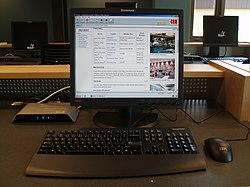
A public thin-client computer terminal inside a public library.

A thin client (sometimes also called a lean or slim client) is a computer or a computer program which depends heavily on some other computer (its server) to fulfill its traditional computational roles. This stands in contrast to the traditional fat client, a computer designed to take on these roles by itself. The exact roles assumed by the server may vary, from providing data persistence (for example, for diskless nodes) to actual information processing on the client's behalf.
 
Thin clients occur as components of a broader computer infrastructure, where many clients share their computations with the same server. As such, thin client infrastructures can be viewed as the providing of some computing service via several user-interfaces. This is desirable in contexts where individual fat clients have much more functionality or power than the infrastructure either requires or uses. This can be contrasted, for example, with grid computing.

Thin-client computing is also a way of easily maintaining computational services at a reduced total cost of ownership.

The most common type of modern thin client is a low-end computer terminal which concentrates solely on providing a graphical user interface to the end-user. 


An Aleutia E3 thin client, with flash memory


The remaining functionality, in particular the operating system, is provided by the server.

History
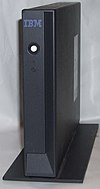
 

IBM EXX thin client

Thin clients have their roots in multi-user systems, traditionally mainframes accessed by some sort of terminal computer. As computer graphics matured, these terminals transitioned from providing a command-line interface to a full graphical user interface, as is common on modern thin clients. The prototypical multiuser environment along these lines, Unix, began to support fully graphical X terminals, i.e., devices running X server software, from about 1984. X terminals remained relatively popular even after the arrival of other thin clients in the mid-late 1990s. 

Modern Unix derivatives like BSD and GNU/Linux continue the tradition of the multi-user, remote display/input session. Typically, X server software is not made available on thin clients, although no technical reason for this exclusion would prevent it.

Windows NT became capable of multi-user operations primarily through the efforts of Citrix Systems, which repackaged NT 3.5.1 as the multi-user operating system WinFrame in 1995. Microsoft licensed this technology back from Citrix and implemented it into Windows NT 4.0 Terminal Server Edition, under a project codenamed "Hydra". Windows NT then became the basis of Windows 2000 and Windows XP. As of 2011 Microsoft Windows systems support graphical terminals via the Remote Desktop Services component.

The term thin client was coined in 1993 by Tim Negris, VP of Server Marketing at Oracle Corp., while working with company founder Larry Ellison on the launch of Oracle 7. At the time, Oracle wished to differentiate their server-oriented software from Microsoft's desktop-oriented products. Ellison subsequently popularized Negris's buzzword with frequent use in his speeches and interviews about Oracle products.

Size comparison - traditional Desktop PC vs Clientron U700

The term stuck for several reasons. The earlier term "graphical terminal" was chosen to contrast such terminals with text-based terminals, and thus puts the emphasis on graphics. The term thin client was also not well-established among IT professionals, most of whom had been working on fat-client systems. It also conveys better the fundamental hardware difference: thin clients can be designed with much more modest hardware, because they perform much more modest operations.

Thin clients as programs


The notion of a thin client extends directly to any client–server architecture: in which case, a thin client application is simply one which relies on its server to process most or all of its business logic. This idiom is relatively common for computer security reasons: a client obviously cannot be trusted with the logic that determines how trustworthy they are; an adversary would simply skip the logic and say "I'm as trustworthy as possible!"

However, in web development in particular, client applications are becoming fatter. This is due to the adoption of heavily client-side technologies like Ajax and Flash, which are themselves strongly driven by the highly interactive nature of Web 2.0 applications.

A renewed interest in virtual private servers, with many virtualization programs coming to a ripe stage, means that servers on the web today may handle many different client businesses. This can be thought of as having a thin-client "virtual server" which depends on the actual host in which it runs to do all of its computation for it. The end result, at least, is the same: providing of the computing service for many clients.

Single point of failure


The server, in taking on the whole processing load of several clients, forms a single point of failure for those clients. This has both positive and negative aspects. On the one hand, the security threat model for the software becomes entirely confined to the servers: the clients simply do not run the software (think of them as a screen, keyboard and mouse - all keystrokes and mouse movements go to the server, which sends back the screen image). Thus, only a small number of computers (the servers) need to be rigorously secured, rather than securing every single client computer. 

On the other hand, any denial of service attack against the server will limit the access of many clients. But the server software is written with virtual machine technology so every client is isolated and a client crash is easily handled and rebooted. The single point of failure still exists, however; if the server crashes, data loss is possible. Therefore, backups are critical.

For small networks, this single-point of failure property might even be expanded: the hosting server can be integrated with file servers and print servers particular to its clients. This simplifies the network and its maintenance, but might increase the risk against that server.

In practice redundancy is provided both in the form of additional connectivity from server to the network as well as in the servers themselves, using features like RAID 5 or better, distributed server (multiple networked servers appearing as one server to the users), VMWare High Availability and Fault Tolerance or Citrix XenApp's load balancing.

Cheap client hardware


While the server must be robust enough to handle several client sessions at once, the clients can be assembled from much cheaper hardware than a fat client can. Many clients have minimal RAM memory, some do not even have a hard drive. This reduces the power consumption of those clients, and makes the system marginally scalable: it is relatively cheap to connect additional client terminals. 

The thin clients usually have a very low total cost of ownership, but some of that is offset by requiring a robust server infrastructure with backups and so forth. This is also reflected in terms of power consumption: the thin clients are generally very low-power and might not even require cooling fans, but the servers are higher-power and almost always require an environmentally controlled air-conditioned server room.

On the other hand, while the total cost of ownership is low, the individual performance of the clients is also low. The processing costs of compiling software, rendering video, or any other computationally intensive task on any client will impact the server and the performance hit will be shared by all clients.

Client simplicity

Gigabyte TA7 thin client  

Since the clients are made from low-cost hardware with few moving parts, they can operate in more hostile environments than conventional computers. However, they inevitably need a network connection to their server, which must be isolated from such hostile environments. Since thin clients are cheap, they offer a low risk of theft in general, and are easy to replace if stolen or broken. Since they do not have any complicated boot images, the problem of boot image control is centralized to the server.

On the other hand, to achieve this simplicity, thin clients sometimes lag behind thick clients (PC Desktops) in terms of extensibility. For example, if a local software utility or set of device drivers are needed in order to support a locally attached peripheral device (e.g. printer, scanner, biometric security device), the thin client operating system may lack the resources needed to fully integrate the needed dependencies. Modern thin clients attempt to address this limitation via port mapping or USB redirection software. However, these methods cannot address all use case scenarios for the vast number of peripheral types being put to use today. 

Slow bitmapped/animated graphics


Thin clients tend to be optimized for use with simple lines, curves, and text, which can be rapidly drawn by the client using predefined stored procedures and cached bitmap data. In this regard, thin clients work well for basic office applications such as spreadsheets, word processing, data entry, and so forth.

However, all thin clients suffer performance problems when large areas of the graphics display must be updated rapidly with high detail bitmap graphics, which may also need to be redrawn several times a second for animation purposes. In a few cases it may be possible to use a video stream that was already previously compressed such as MPEG or H.264 video, but many graphical programs such photo editors, 3D drawing programs, and animation tools require high-detail uncompressed bitmaps to be displayed in order for the software to be used effectively.

Graphics-rich 3D games can be completely unusable on a thin client unless the updated screen area is kept very small or the overall screen resolution is very low, to reduce the amount of data sent to the client.

In an attempt to reduce network bandwidth, the server may try to compress high-detail bitmaps on the fly before sending the data to the client, but this adds latency to the client-server communications, and may reduce user interface responsiveness. Many thin clients offer options to turn off various graphics-rich user interface effects in order to increase performance, such as not showing the contents of a window while dragging or not displaying a desktop background.

Recent trends


Web-centric thin client


Ultra-thin client


Traditionally, a thin client ran a full operating system for the purposes of connecting to other computers. A newer trend is sometimes called an ultra-thin client or a zero client, which no longer runs a full operating system: the kernel instead merely initializes the network, begins the networking protocol, and handles display of the server's output.

Web thin client


Web thin clients (running a Web operating system) rely on web-based software for the application and data storage. While this configuration requires minimal hardware, it is entirely dependent on a single point of failure: the Internet connection.

RTE client


A Run Time Environment (RTE) client contains task-specific applications (e.g. Mozilla Firefox for Internet browsing) and only the minimal (often customized) underlying and supporting code (BIOS, firmware, kernel, libraries, plug-ins, etc.) to run only those applications. It contains all and only the code needed to accomplish its specific task, thus its more than a zero client but less than typical thin client computer. The RTE client does not have a general purpose operating system - it usually lacks shells (terminal windows), is not designed to be patched (updated online), has minimal connectivity to external resources, and is often found in read-only media (e.g. tamper-resistant ROM chips, CD-ROM, etc.). Attempts to inject or run any other applications/processes/threads results in crashing the kernel (system). Due to the need to physically update the device, RTE clients are mostly found in stable environments demanding high security.

TCS to hire 25,000 from campuses next year

 TCS to hire 25,000 from campuses next year
 
New Delhi, Oct 21: Tata Consultancy Services (TCS) has said it plans to hire 25,000 persons from campuses in the next fiscal.

"Campus recruitments, yes, we've already started and we've started from seventh semester as what we've discussed with Nasscom. As far as next year is concerned, we will be doing at least 25,000, that is what is our target at this point of time is," TCS Executive Vice President and Global Head (Human Resources) Ajoy Mukherjee told reporters here.

He added that about 12,000 offers have already been made. With fresh graduates continuing to join the company, there was a total gross addition of 18,654 people during the July-September 2012 quarter.

The net addition stood at 10,531 people during Q2, taking the total employee strength to 2,54,076 on a consolidated basis at the end of September 30, 2012.

TCS plans to add about 50,000 employees during FY'13. Of the total gross additions, fresh graduates accounted for 69 per cent in India. The utilisation rate (excluding trainees) was at 81.6 per cent and including trainees at 72.8 per cent.

The attrition rate (last 12 months (LTM) basis) was at 11.4 per cent overall, including IT and BPO.

"We are delighted to have increased our retention rate further to 88.6 per cent. We have also been able to increase our utilisation rate, including trainees, despite adding over 10,000 fresh graduates during the quarter," Mukherjee said.

TCS added 41 clients during the quarter, helping the company post 49.2 per cent jump in consolidated net profit at Rs. 3,434 crore for the quarter ended September 30, 2012.

The USD 100 billion Indian IT outsourcing industry, which earns close to 80 per cent of its revenues from the US and Europe, has been facing difficult business environment as IT budgets of clients remain flat.

Fierce competition and rise in operational costs has also added to the impact.

However, TCS CEO and MD N Chandrasekaran exuded confidence in continuing the growth momentum. "We are pretty confident on margins and positive on growth," he said adding that discretionary spends by clients continues.

Saturday, October 20, 2012

New technology can produce 'petrol from air'

http://cdn.overclock.net/7/7a/350x700px-LL-7ac4a960_solar.jpeg

A small British firm claimed to have developed a revolutionary new technology that can produce petrol using just air and electricity.

A company in the north of England has developed the "air capture" technology to create synthetic petrol which experts have hailed as a potential "game-changer" in the battle against climate change and a saviour for the world's energy crisis. 

The technology, presented to a London engineering conference this week, works by removing carbon dioxide from the atmosphere, The Telegraph reported.
The 'petrol from air' technology involves taking sodium hydroxide and mixing it with carbon dioxide before 'electrolysing' the sodium carbonate that it produces to form pure carbon dioxide. 

Hydrogen is then produced by electrolysing water vapour captured with a dehumidifier. 

The company, Air Fuel Syndication, uses the carbon dioxide and hydrogen to produce methanol which in turn is passed through a gasoline fuel reactor, creating petrol. 

Company officials claimed to have produced five litres of petrol in less than three months from a small refinery in Stockton-on-Tees, Teesside. 

The fuel that is produced can be used in any regular petrol tank and, if renewable energy is used to provide the electricity it could become "completely carbon neutral". 

The company hopes to build a large plant, which could produce more than a tonne of petrol every day, within two years and a refinery size operation within the next 15 years. 

Institution of Mechanical Engineers (IMechE) officials admitted that while the described technology is "too good to be true but it is true", and said that it could prove to be a "game-changer" in the battle against climate change. 

Stephen Tetlow, the IMechE chief executive, hailed the breakthrough as "truly groundbreaking". 

"It has the potential to become a great British success story, which opens up a crucial opportunity to reduce carbon emissions," he was quoted as saying by the paper. 

"Air capture technology ultimately has the potential to become a game-changer in our quest to avoid dangerous climate change," Dr Tim Fox, the organisation's head of energy and environment, added. 

Peter Harrison, the company's 58-year-old chief executive said that he was "excited" about the technology's potential, which "uses renewable energy in a slightly different way". 

"People do find it unusual when I tell them what we are working on and realise what it means. It is an opportunity for a technology to make an impact on climate change and make an impact on the energy crisis facing this country and the world, said Mr Harrison, a civil engineer from Darlington, County Durham. 

"It looks and smells like petrol but it is much cleaner and we don't have any nasty bits," he said.