LATEST TECHNOLOGY NEWS | GADGET REVIEWS | SOCIAL MEDIA UPDATES | INFORMATION TECHNOLOGY NEWS | MOBILE WORLD | CAR WORLD | NATIONAL-INTERNATIONAL NEWS AND MANY MORE..........

Pages

Translate My Page

Sunday, October 14, 2012

Nikon Coolpix S800c 1st Android-powered camera launches for Rs. 20,950

The Nikon Coolpix S800c packs in a 16MP slab of image-capturing silicon along with a 25-250mm (10x) optical zoom lens with a variable aperture of f/3.2-5.8. Also included is 1.7GB of internal memory along with Wi-Fi and Bluetooth radios, thanks to the companion app Nikon has made for both iOS and Android that allows the camera to connect to any of the iOS or Android devices for easy transfer. 

The interface on the back of the Coolpix S800c is all touch based and the large 3.5 inch display.

Other features include a 9-point AF system with automatic selection along with lens based Vibration Reduction.

The screen is based on OLED design with an anti-reflective coating to help ease the viewing and shooting process even under the mid-day sun.


The S800c is running on Android 2.3 (Gingerbread) which is a 2 generation old OS. When compared with the Galaxy Camera from Samsung, which runs the newest Android build (Jelly Bean).

While there is no word on the processing power the Nikon packs, the Samsung contender is running off of an Exynos 4 chips, which is a quad-core processing beast.

 http://technabob.com/blog/wp-content/uploads/2012/08/nikon_coolpix_s800c.jpg

The Coolpix S800c is now available at various Nikon authorized outlets and can be had for Rs. 20,950, however, we would recommend waiting for our in-depth review of the camera before you commit that hard earned money to it.

Karbonn launches A11, A7+ and A1+ Android Smartphones

undefined

The Karbonn A11 is the best equipped amongst the three. It sports a 4-inch display, runs Android 4.0 ICS and is powered by a 1GHz single-core processor. It also includes a 5 megapixel rear camera with autofocus and LED flash along with a secondary front facing 1.3 megapixel camera. It includes a 1,500 mAh battery.

The Karbonn A7+ is a device which runs Android 2.3.6 Gingerbread and sports a 3.5-inch display. It is also powered by a 1GHz single core processor, has a 5 megapixel camera with autofocus and LED flash and a secondary VGA quality front facing camera. It includes a 1,420 mAh battery.

The Karbonn A1+ is not much different than the A7+. It is also powered by a 1GHz single-core processor, sports a 3.5-inch display, runs Android 2.3.6 Gingerbread. However it includes a 3 megapixel rear camera and a secondary VGA quality front facing camera. The device is equipped with a 1,500 mAh battery.

The A11 is officially priced at Rs. 9,990, the A7+ is officially priced at Rs. 8,990, and finally the A1+ is officially priced at Rs. 4,990, quite possibly be the most affordable Android smartphone with a 1GHz processor.

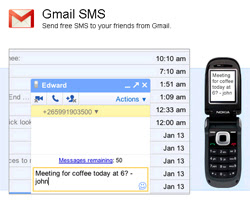
Now send free SMS from Gmail, supports all Indian cellular operators


Google has rolled out its new 'free SMS' service from its free email service Gmail. This service allows users to send messages to mobile phones from the Gmail chat window.

Users just have to add mobile numbers of their contacts in the email address. The SMS sent from Gmail chat are delivered to mobile phones while replies from the mobile phone come into the chat window.

Currently the service has 50 SMS credits for each user, every sent SMS costs one credit while a received message adds on 5 credits subject to the maximum level being 50 SMS at any given time. 

Google has rolled out the SMS service in partnership with all cellular operators in India now.

Google says,"If you'd like a higher message credit, you can always send an SMS to your own phone, and then reply to that message multiple times. Every time you send a reply message, your SMS credit is increased by five. 

Effectively, you're buying more messages by paying your phone company for these outgoing messages".

Google does not charge for using the SMS service. However, standard charges by cellular operators will apply to any SMS messages sent from a mobile device to Google Chat.

If the credit balance becomes 0, Google says, "It will increase back up to one credit, 24 hours later. So, you won't ever be locked out of the system."

Friday, October 12, 2012

Samsung launches Smaller & Cheaper - Galaxy S III Mini

Samsung launches Galaxy S III Mini
This handout photo taken and received by Samsung Electronics on October 12, 2012 shows a scaled-down, compact version of its flagship Galaxy S III for consumers looking for 'more practical' smartphones. Galaxy S III Mini is smaller and lighter than the S III, it is also equipped with a four-inch touchscreen. 


Seoul, October 12, 2012


Samsung Electronics on Friday unveiled a compact version of its flagship Galaxy S III smartphone, with a touch screen sized to match that of arch-rival Apple's new iPhone 5.

The Galaxy S III Mini has a four inch high-definition touch screen, compared to the 4.8 inch version on it's
larger Samsung sibling, but the size reduction is offered at a technical price.


Models hold a Samsung 'Galaxy S3 mini' (R) phone and a 'Galaxy S3' phone during the mini's world premiere in Frankfurt. Reuters photo
 
The display has a lower resolution of 800x480 pixels compared to 1,280x720 pixels, the camera is five rather than eight megapixels and the S III's dual-core 1.5GHz processor has been downgraded to 1GHz.

"It can be an optimal choice for consumers who are looking for more practical smartphones," Samsung said in statement.

The company gave no details on pricing or an eventual sales date.

The Mini's screen is the same size as the iPhone 5 launched last month by Apple, but its reduced feature set makes it more of a corner man in the heavyweight clash between the iPhone 5 and the S III.

Samsung and Apple are currently embroiled in a bitter legal battle spread over 10 countries over alleged patent infringements.

Initial reactions to the new Samsung product were underwhelming.

"The only iPhone it may be capable of beating is the 3GS from 2009," said a review in the Los Angeles Times, which said the Mini's inability to connect with 4G networks was "unacceptable for any phone trying to be a major player".

Wired magazine bemoaned the lower resolution on the touch screen and said the final product was a "big compromise in a small package".

But some industry analysts said comparisons with the features boasted by top-end smartphones were missing the point.

"This is a lower-end product and it is not really a competitor for iPhone 5," said James Song, a tech analyst at Daewoo Securities.

The Mini does boast many of the same software features as the S III.

It is powered by the latest Android 4.1 Jelly Bean operating system, packed with S Voice, a language recognition software, and Smart Stay which keeps the screen lit as long as you are looking at it.

Other features include direct call, which enables you to automatically dial a call simply by lifting the phone to your ear when reading a text message from your friend.

S Beam allows the user to share music files between Galaxy S III series and Galaxy Note II devices simply by tapping the phones together.

Shin Jong-Kyun, who leads Samsung's IT and Mobile Communications Division, told reporters earlier this week that the Mini was aimed at meeting strong demand in Europe for smartphones with four inch screens.

"Some people call the new model a lower-end version of the Galaxy S III but we prefer the mini tag," Shin said.


Indian Railways sets up "RAILRADAR" train tracking system


One of the largest railway operators, Indian Railways, has set up an interactive train monitoring platform for commuters to track train movements around India almost in real time, which has helped people better plan their trips ahead of time.

The service, called RailRader, was jointly developed by the Centre for Railway Information Service (CRIS) and RailYatri.in and can be accessed on Web browsers on both traditional PCs and mobile phones. Sunil Baipai, group general manager at CRIS, shared that since the service was launched on Thursday, it has received over 200,000 hits and some 20 percent of the traffic was from mobile users.

The online service uses color codes to aid users: blue arrows on the screen indicate trains that are currently running on time, while red arrows refer to trains running late. The arrows also indicate the direction in which the train is heading toward, and to get more information about the train, users can just click or hover over the train icon using one's mouse, the railway company stated.

However, information on train location and status are typically delayed by about five minutes due to security and regulatory reasons, it added.


indiatraintracking

 
In order to monitor its train network, Indian Railways has installed monitoring points at more than 6,000 locations around the country. These outposts communicate updates--mostly automatically although some still rely on manual reporting--on train arrivals and departures to a central server, which then analyzes the large amounts of data in real time. Typically, about 10,000 trains run daily in India, the company noted.

Harpreet Singh, who manages operations at a startup and is a frequent traveler, told that he was excited about RailRadar. He says the service comes in handy when he has to pick someone up from the train station or when he has to make one or several train connections to get to his location.

The ability to find out whether the train is on time to reach his intended destination using mobile Internet is another plus, Singh noted.

Indian Railways, which is a state-owned enterprise, is no stranger to technological innovation. Its catering, tourism and online ticketing subsidiary, Indian Railway Catering and Tourism Corporation (IRCTC), pioneered the online booking service for train tickets and became one of the largest, fastest-growing e-commerce portals in the Asia-Pacific region in a short period of time.

Wednesday, October 10, 2012

Hackers using Skype to attack Windows PCs

http://www.pinoytechnologies.com/wp-content/uploads/2012/10/Cybercriminals-Attack-Skype-By-Using-Botnet-Malware.png

LONDON: Free internet-calling service Skype is being used by hackers to distribute a 'worm' that infects users Windows PCs.

On clicking an instant message saying "lol is this your new profile pic?" users are unwittingly downloading a file containing a Trojan horse malware file.

This opens a backdoor allowing hackers to hijack infected PCs and recruit them into a "botnet army".

Users can be locked out of their machines and held to ransom, the BBC reports.

According to the report, Skype said in a statement that they 'are aware of this malicious activity and are working quickly to mitigate its impact.'

"We strongly recommend upgrading to the newest Skype version and applying updated security features on your computer," the firm said in a statement.

"Additionally, following links - even when from your contacts - that look strange or are unexpected is not advisable," it added.

Google, Yahoo hijacked in Ireland, users rerouted to fraud sites


LONDON: Ireland's internet domain authority said that Irish pages belonging to Yahoo and Google were hijacked on Tuesday following an unauthorised change to their registrar's account.

The IE Domain Registry, which administers Ireland's .ie internet code, said in a statement that visitors to two high-profile Irish sites were redirected to "allegedly fraudulent addresses" on Tuesday. The registry didn't identify the sites by name, but Irish internet users flooded the web with complaints about www.google.ie and www.yahoo.ie .

Google said in a statement that some users might be having trouble accessing its Irish site and said it was working to fix the problem. Yahoo did not immediately return several messages seeking comment.

San Francisco-based MarkMonitor, the registrar responsible for both addresses, blamed lax standards at the Irish registry level for the incident. That was a sentiment backed by Michele Neylon, the chief executive of Ireland's Blacknight web hosting company.

"It wouldn't be that hard to hijack a high-profile .ie domain name," he said in a telephone interview. "What happened today could've been a lot worse and could happen to any number of big names."


Two US scientists win Nobel for Chemistry


Dr. Robert Lefkowitz, of Duke University Medical Center. Lefkowitz along with American Brian Kobilka have won the 2012 Nobel Prize in Chemistry. File Photo: AP
Dr. Robert Lefkowitz, of Duke University Medical Center. Lefkowitz 

Brian Kobilka
Americans Robert Lefkowitz and Brian Kobilka won the 2012 Nobel Prize in chemistry on Wednesday for studies of protein receptors that let body cells sense and respond to outside signals. Such studies are key for developing better drugs. 

The Royal Swedish Academy of Sciences said the two researchers had made groundbreaking discoveries on an important family of receptors, known as G-protein-coupled receptors. 

About half of all medications act on these receptors, so learning about them will help scientists to come up with better drugs. 

The human body has about 1,000 kinds of such receptors, which let it respond to a wide variety of chemical signals, like adrenaline. Some receptors are in the nose, tongue and eyes, and let us sense smells, tastes and vision. 

Dr. Lefkowitz, 69, is an investigator at the Howard Hughes Medical Institute and professor at Duke University Medical Center in Durham, North Carolina. Dr. Kobilka, 57, is a professor at Stanford University School of Medicine in California. 

“I’m feeling very, very excited,” Dr. Lefkowitz told a news conference in Stockholm by phone. “I did not hear it ... I wear earplugs, so my wife gave me an elbow,” he said. “And there it was. ... It was a total shock and surprise.” 

Dr. Lefktowitz said he had no clue that he was being considered for the Nobel Prize, though he added it has always been “a bit of a fantasy” to receive the award. 

Dr. Kobilka said he found out around 2-30 a.m., after the Nobel committee called his home twice. He said he didn’t get to the phone the first time, but that when he picked up the second time, he spoke to five members of the committee. “They passed the phone around and congratulated me. I guess they do that so you actually believe them. When one person calls you, it can be a joke, but when five people with convincing Swedish accents call you, then it isn’t a joke.” 

The academy said it was long a mystery how cells interact with their environment and adapt to new situations, such as when adrenaline increases blood pressure and makes the heart beat faster. Scientists suspected that cell surfaces had some type of receptor for hormones. 

Using radioactivity, Dr. Lefkowitz managed to unveil receptors including the receptor for adrenaline, and started to understand how it works. Dr. Kobilka’s work helped researchers realize that there is a whole family of receptors that look alike a family that is now called G-protein-coupled receptors. 

The award is “fantastic recognition for helping us further understand the intricate details of biochemical systems in our bodies,” said Bassam Z. Shakhashiri, president of the American Chemical Society. “They both have made great contributions to our understanding of health and disease,” Dr. Shakhashiri said. “This is going to help us a great deal to develop new pharmaceuticals, new medicines for combating disease.” 

Mark Downs, chief executive of Britain’s Society of Biology, said the critical role receptors play is now taking for granted. “This ground breaking work spanning genetics and biochemistry has laid the basis for much of our understanding of modern pharmacology as well as how cells in different parts of living organisms can react differently to external stimulation, such as light and smell, or the internal systems which control our bodies such as hormones,” Mr. Downs said in a statement. 

The Nobel week started Monday with the medicine prize going to stem cell pioneers John Gurdon of Britain and Japan’s Shinya Yamanaka. Frenchman Serge Haroche and American David Wineland won the physics prize Tuesday for work on quantum particles. 

The Nobel Prizes were established in the will of 19th century Swedish industrialist Alfred Nobel, the inventor of dynamite. Each award is worth 8 million kronor, or about $1.2 million. The awards are always handed out on Dec. 10, the anniversary of Nobel’s death in 1896.

Micromax enters India LED TV's market: What you need to know

Actress Genelia D'Souza and Rajesh Agarwal Managing Director, Micromax, during the launch of new range of LED TVs in New Delhi.
 
After a successful run in the mobile phone and tablet space, Micromax has entered the competitive consumer electronics arena, with the launch of a series of LED TVs, and home entertainment systems, as well as an Android dongle for televisions.

Micromax’s LED TV offerings range from 24-inch to 55-inch, and their prices start from Rs 15,990 and go all the way up to Rs 1,29,990. The 50-inch and 55-inch models offer 3D capabilities, and come with four pairs of 3D glasses. The company claims these TVs will have zero bright spot LEDs for better viewing experience.

Here’s a closer look at the models and their respective pricing and features:

Micromax LED42K316 measures 42 inches, and offers Full HD 1080p resolution. The company has priced it at Rs 47,990. It has 3 HDMI ports, 2 USB ports, a headphone slot, and an input for PC audio.


Micromax LED42K316


Micromax LEDT770K55F is the company’s top-end model in the LED TV segment priced at Rs 1,29,990. This 55-inch model offers Full HD 1080p resolution, and includes a Smart TV feature for Internet browsing, and apps. It also contains 4 HDMI ports, and 2 USB ports.

Micromax LEDK316K50F, measures 50 inches, and has been priced at Rs 79,990. The LED TV offers a Full HD 1080p resolution. It comes with a response time of 6.5ms. As far as connectivity is concerned, the TV comes equipped with 3 HDMI ports, a headphone slot, 2 USB ports, and an input for PC audio.
 
Micromax LED32K316 has a 32-inch screen and is priced at Rs 25,990.

The LEDL31FL24F and the LED24K316 have been priced at Rs 16,990 and Rs 15,990, respectively. Both these devices measure 24 inches.

Micromax LED TVs, at the outset, will be available across 170 cities in the nine states of Delhi, Haryana, Madhya Pradesh, Punjab, Maharashtra, Rajasthan, Andhra Pradesh, Karnataka and Gujarat.

The company also launched the Micromax Smart Stick, which is a dongle running on Android Ice Cream Sandwich. With its Smart Stick, Micromax claims to bring the Android experience to a television screen. 

The Smart Stick has 4GB of flash memory, Direct Wi-fi connectivity and also enables connection with a wireless mouse and keyboard, that will cost Rs 4,990. Micromax also has on offer a BluRay player supporting both 2D and 3D audio/ video formats, which it has priced at Rs 6,490.

Saturday, October 6, 2012

Talking on mobiles for over 6 minutes can be dangerous

http://www.nwoow.com/wp-content/uploads/2012/08/Goa-govt-to-consider-ban-on-use-of-mobiles-by-constables-on-duty.jpg
 
MUMBAI: You can reduce the radiation risks posed by cellphones if you religiously avoid talking on your mobile for more than six minutes. But since it can be an unrealistic target for many, using a speakerphone or headset and keeping the mobile at least a foot away from the body is the safest option, experts say.

Most importantly, reduce the number of calls from cellphones and use the SMS option instead, or landlines whenever possible. Above all, don't forget to check the specific absorption rate (SAR) while buying a phone, it should be strictly 1.6 watt/kg and not beyond it, suggest telecommunication officials.

If at all you are exposed to radiation from cell towers, or if your residence or office is within 1km from a TV tower or within 500 meters of an FM tower, then growing plants or trees with more water content, or putting water curtains on windows or galleries are other ways to divert radiation.

But the best option is to complain against such a tower. An inter-ministerial committee of experts formed by the ministry of communications and information technology to study the hazards posed by cellphones and towers has already highlighted that radiation from cellphones and towers poses serious health risks, including loss of memory, lack of concentration, disturbance in digestive system and sleep disorders.

In June last year, the WHO and International Agency for Research on Cancer (IARC) classified radiofrequency electromagnetic fields as Group 2B agents that could "possibly be carcinogenic to humans," or in simpler words cause brain cancer. Globally, researches are still trying to gauge health hazards caused by prolonged use of cellphones.

Senior consultant radiation oncologist Dr Anusheel Munshi said while more data is awaited, preliminary findings could be strong enough for people to think prevention. "So far, prolonged usage for at least a decade has been linked with brain tumours. It is believed that constant exposure of certain regions of the brain to electromagnetic radiation is to blame for tumours," he said. Munshi also suggested that plug-in ear devices should be used more often and even texting could be used more frequently than talking.

A paediatrician from civic-run Sion Hospital said cell phone usage should be kept to minimum for children. "The damages could be more in case of children as their skull bones are thinner than adults and therefore electromagnetic radiation could penetrate deeper," the doctor said.

R K Bhatnagar, advisor (technology ) to the department of telecommunications, said even corrective action such as reducing the frequency of the antennas, changing their position and direction can also help reduce the effects of radiation on humans. "Re-engineering is possible in most cases, which can give lot of relief but in extreme cases removing them can be the final option," he said.

Thursday, October 4, 2012

SBI To Bring In Talking ATMs To Help Visually-Impaired

talking ATMs, ATM, SBI ATM, ATM machine
NCR Corporation will upgrade over 2,500 SBI ATMs to Voice-Guided ATMs across India to help the visually-impaired as well as differently-abled.
 
Thursday, October 04, 2012:  The State Bank of India (SBI) in response to RBI’s objective of providing financial accessibility to every citizen in India irrespective of his or her disability has announced that it will be upgrading over 2,500 ATMs across India to help the visually-impaired. NCR Corporation, one of India’s largest ATM service provider, will transform over 2,500 SBI ATMs to Voice-Guided ATMs, which will allow access to its ATMs not only to visually-impaired people, but also to people with physical disabilities through ramps for wheel chair access.


SBI’s first ATM for the visually impaired was showcased today at Antarchakshu, a sensitisation workshop, organised by Xavier's Research Centre for the Visually Challenged (XRCVC) at Jawaharlal Nehru University in Delhi.

NCR’s "Talking ATMs" are incorporated with unique software and hardware features which ensures that a person with a disability can operate the machine on their own, while maintaining the safety of the transaction. These ATM machines are designed as per Access for All (AFA) standards and comprises accessible keypads, voice-guidance technology, braille stickers and multi-lingual capability.

Apart from reading aloud screen messages, the machine also provides complete orientation making it easy for the customer to use the machine. An important security feature of this ATM is that it provides a person with an option to blank out the screen as a safety mechanism to avoid shoulder surfing by any by-stander trying to access customer data during the transaction. 
 
The NCR "Talking ATM" uses a text-to-speech engine which allows voicing out the text on the screen in multiple languages for consumer convenience. Instead to issuing "Special Cards" for the customers with disabilities, since it can become difficult to maintain track of whether the correct card has been issued, SBI has chosen to make its existing ATM network AFA-compliant by simply customising their existing ATM software stack and upgrading the hardware configuration of its ATM fleet.


Adobe launches new version of Acrobat

 
Adobe logo.

Adobe, the creator of the popular portable document format (PDF), on Wednesday, announced the release of the latest version of its PDF reader, the Acrobat XI suite. 

Speaking at the launch, Umang Bedi, Managing Director, South Asia, Adobe, said the new suite had the flexibility to not only enable editing of PDF documents but also “seamless” integration with the Microsoft Office family of document formats as well as Sharepoint, a Web application platform developed by Microsoft. 

Acrobat XI would enable editing and sharing of documents across multiple form factors such as mobile phones, laptops and tablets in a seamless manner, Mr. Bedi said.

The new Malayali world of DNA

A screen shot of the BMC Genomics open access, peer-reviewed journal that published the study by SciGenom Laboratories.
 
 A Kochi-based laboratory has completed the full sequencing and analysis of the first Malayali personal genome, revealing the genetic diversity of the linguistic group and signalling a revolution in disease diagnosis and treatment. 

The study by SciGenom Laboratories established that the Malayali is genetically similar to the Caucasians more than any other race on earth.

A detailed report on the analysis has been published after peer review by BMC Genomics, an international medical journal that identifies and pools research contributions in genomics. Investigators at SciGenom Labs had joined hands with Stephan C. Suschter's laboratory at Pennstate, USA, and others to analyse the genome sequencing data. 

The report carries elaborate comparison of Malayali genome against other published genomes from other parts of the world. The study revealed that the gene sequence of the Malayali varies from Chinese and African genomes but stands closer to the Caucasian, a term denoting the white race. 

Genetic diversity
 
According to the report, the availability of this genome and the variants identified is a first step in understanding the genetic diversity in the Indian subcontinent, a crucial factor in identifying clinically relevant changes. These changes, along with further studies on additional genomes from this region, should provide a comprehensive assessment of the disease burden in the Indian population, it concluded. 

Dr. George Thomas, Director, SciGenom Labs, said this was the first complete sequencing of a South Asian Indian female (SAIF) genome. “The real challenge with regard to the data obtained from genome sequencing is its analysis for arriving at sound conclusions. The analysis enables listing out those genetic deformities and hidden diseases in an individual which would come out in future,” he said. 

“So diseases such as cancer, diabetes, liver diseases, and Alzheimer’s would become predictable and there could be preventive treatment and personalised drugs. This is the field occupied by bioinformatics and India needs to develop a good number of experts in this field,” he said. 

The sequencing and genotype data has been deposited at the European Genome-Phenome Archive, hosted by the European Bioinformatics Institute (EBI). The SAIF variant information could be viewed at http://gbrowse.scigenom.com. and the full report published by BMC Genomics was available at http://www.biomedcentral.com/1471-2164/13/440, a press note issued by SciGenom Laboratories said.

Three computing technologies that will power the future


From the initial days of number-crunching by languages of FORTRAN, to the procedural methodology of Pascal or C, and later, the object-oriented paradigm of C++ and Java, we have come a long way. In this age of information overload, technologies that can just solve problems through steps and procedures are no longer adequate. 

We need technology to detect complex patterns, trends, understand nuances in human language and to automatically solve problems. In this new era, the following three technologies are furthering the frontiers of computing technology:

Predictive analytics

By 2016, 130 exabytes will rip through the Internet. The number of mobile devices will exceed the human population this year, and by 2016, the number of connected devices will touch 10 billion. 

Devices connected to the Net will range from cellphones, laptops, tablets, sensors and the millions of devices based on the ‘Internet of things’. A hot and happening trend in computing is the ability to make business and strategic decisions by determining patterns, trends and outliers among mountains of data. Predictive analytics will be a key discipline in our future and its experts will be much sought after. 

Predictive analytics uses statistical methods to mine intelligence, information and patterns in structured, unstructured and streams of data. Predictive analytics will be applied across many domains, including banking, insurance, retail, telecom and energy. 

There are also applications for energy grids and water management, besides those that determine user sentiment by mining data from social networks.

Cognitive computing

The most famous technological product in the domain of cognitive computing is IBM’s supercomputer, Watson, an artificial intelligence computer system capable of answering questions posed in natural language. 

Watson is best known for successfully trouncing a national champion in the popular U.S. TV quiz competition, Jeopardy. What made this victory more astonishing was that the supercomputer was able to decipher the nuances of natural language and pick the correct answer. 

Following the success at Jeopardy, Watson has now been employed by a leading medical insurance firm in the U.S. to diagnose medical illnesses and recommend treatment options for patients. Watson will be able to analyse 1 million books, or roughly 200 million pages of information. Another well-known example of cognitive computing is Siri, the voice recognition app on the iPhone. The earlier avatar of cognitive computing was expert systems based on artificial intelligence. These expert systems were inference engines that were based on knowledge rules. 

The most famous among the expert systems were ‘Dendral’ and ‘Mycin’. 

Autonomic computing 


This is another computing trend that is set to become prevalent in the networks of tomorrow. Autonomic computing refers to the self-managing characteristics of a network. Typically, it signifies the ability of a network to self-heal in the event of failures or faults. 

Autonomic network can quickly localise and isolate faults in the network while keeping other parts of the network unaffected. Besides, these networks can quickly correct and ‘heal’ the faulty hardware without human intervention. Autonomic networks are typical in smart grids where a fault can be quickly isolated and the network healed without resulting in a major outage in the electrical grid. 

These are truly exciting times in computing as we move towards true intelligence.

Indian call centre disgrace: scareware scammers trick Americans

New York: US officials said on Wednesday that they had shut down six “scareware” scammers, mostly operating from call centres in India. They tricked over a million Americans into thinking their computers were infected with viruses and scared them into buying software to “fix” their non-existent problems.

America’s Federal Trade Commission (FTC) worked with its counterparts in Canada and Australia to identify and track the crooked call centres that were located around the world, but were largely concentrated in India. Microsoft also played a part in identifying the scammers.

The scammers stayed under the radar by using virtual offices, more than 80 different domain names and 130 different phone numbers. The agency said many of the scammers from India were using US carriers, and the carriers agreed to block the numbers. This is one of the most widespread Internet scams of the decade and has duped people out of millions of dollars.

The FTC told Firstpost that it is working with Indian agencies, but did not disclose confidential details as it said it could not talk about ongoing investigations.


“In these outrageous and disturbing cons you get a call from someone pretending to be from a major computer company who dupes you into thinking you have a virus on your computer,” FTC chairman Jon Leibowitz told a press conference, which also played an audio tape of one of the calls.

“At one level, it’s like a bad Bollywood movie, but at another level it’s a rip-off of consumers,” he added.

The FTC has filed charges against six so-called tech support companies for running the “scareware” scheme on tens of thousands of victims. A US District Court judge, at the agency’s request, ordered a stop to the scam.

According to Bloomberg, the court froze $180,000 in assets belonging to the six companies involved in the scam. It has also taken measures to block phone lines and websites the companies used to contact customers.

The companies in the dock are: Pecon Software Ltd., Lakshmi Infosoul Services Pvt. Ltd., Finmaestros LLC, Zeal IT Solutions Pvt. Ltd., Virtual PC Solutions and PCCare247, Inc.

Leibowitz said the frozen assets could be distributed to victims once they are identified, but he warned it’s rare to “get 100 percent back in restitution.”

The orders against the companies, most of them based in India, came a day after the final defendant in another scareware case dating back to 2008 was ordered to pay $163 million in restitution.

Decoding the “scareware” scam

The duplicity worked simply: Call centre workers pretending to be affiliated with Dell, Microsoft, McAfee, Norton or Microsoft cold-called Americans about supposed computer problems and said they had detected malware on their systems.

They directed unsuspecting computer users to a Microsoft Windows menu, and scared them by telling them that standard warning messages displayed there indicated malicious programs were already on their machines.

People were then convinced to grant the callers remote access to their computer. When the victim paid, the scammers delivered useless, free or even malicious software. Often, they also used the victim’s credit card number for further fraud.

The groups also used online ads to present deceptive websites that peddled scareware to unsuspecting Internet users. They sold “fixes” at prices ranging from $49 to $450.

“These so-called tech support scams are the latest variation of scareware,” said Leibowitz. “They have taken scareware to a whole other level of virtual mayhem. Today’s announcement is a wake-up call to computer users around the globe.”

Canada’s top telecom regulatory official, Andrea Rosen of the Canadian Radio-Television and Telecommunications Commission, said two related enforcement actions were filed in Canada.

“We make a difference by working together,” said Rosen, while highlighting how the agencies and regulators collaborated across borders to investigate and quash the massive scareware scam.

Wednesday, October 3, 2012

Oracle launches new Exadata servers, updated database 12c


SAN FRANCISCO: Oracle Chief Executive Officer Larry Ellison, seeking to reverse slowing growth, unveiled a high-end server with more memory and an updated flagship database to compete against SAP.

Computing power and storage, applications software and Oracle's database will also be sold as a cloud service businesses can rent instead of buying outright, Ellison said on in an address at the company's OpenWorld conference. Ellison is depending on new products and a shift to cloud services to boost sales at the world's largest supplier of database software.

Oracle's share-price has underperformed SAP and Salesforce.com, its rivals in providing cloud computing for businesses. The revamped 12c database is Oracle's first new version for its flagship in five years. "Oracle should be in this business," said Rick Sherlund, an analyst at Nomura Holdings, who recommends buying the shares.

"Oracle has to reposition for the cloud." The 12c database will let customers move their computing jobs from data centers to the internet, Ellison said. "You can access all of these services across the network," he said at the conference in the Moscone Center in San Francisco. "It makes sense for Oracle to be in all three tiers of cloud services."

More memory
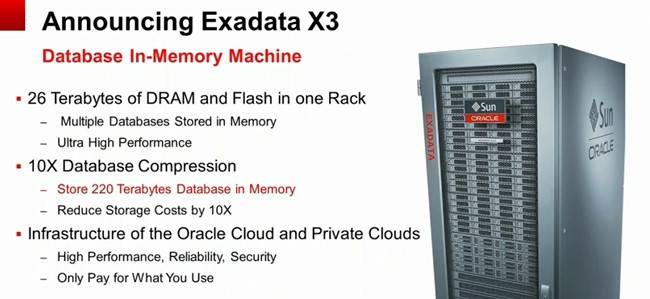
The new Exadata servers -- which pack computing power, storage capacity and high-speed networking into a single chassis to speed performance of Oracle's database - can set the company apart from competitors, co-president Mark Hurd said last week. The company's addition to its Exadata line of servers, called the X3, will be able to house as much as 22 terabytes of flash computer memory and four terabytes of DRAM in a single server rack to greatly speed up business reports. That's four times as much flash storage per rack than a previous version of Exadata, Ellison said.

"If you thought the old Exadatas were fast, you ain't seen nothing yet," said Ellison, wearing a suit and black turtleneck and standing before eight giant screens bearing his slides. Sales for the Redwood City, California-based company declined 2.3% in the fiscal first quarter ended August, dragged down by a drop in the hardware business acquired from Sun Microsystems in 2010. The revenue number missed analysts' estimates as computer hardware sales declined for a sixth straight period.

Cloud computing
New software license sales, a measure of freshly signed business - tapered to 5% growth in the quarter, from more than 16% a year ago. Ellison said Oracle is "ideally positioned" to deliver many components of hardware and software - including its database, application-connecting middleware and computer systems - as a cloud computing service delivered entirely through the Internet, or with some equipment sitting in customers' data centers.

He has said the 12c database will let Oracle serve multiple companies' data-processing needs from the same information storehouse and will arrive by early next year. The company's Exadata and Exalogic systems, plus its database, Java development tools and social media-analysis software, can be delivered to businesses as a service Oracle manages over the internet, Hurd said in an interview last week.

Growing data
Hurd, along with other Oracle executives including Ellison, will be speaking at the OpenWorld conference this week, which opened on Sunday and runs through October 4. International Business Machines (IBM), Microsoft and VMware are also vying to supply more of the platform software that can help companies move to cloud computing.

SAP's High Performance Analytical Appliance uses hardware from IBM, Hewlett-Packard and others to store data in computer memory for faster analysis. SAP is the top business applications maker. Before the first-quarter sales decline, Oracle's revenue growth had fallen to 1.3% in the previous quarter, compared with 12% a year earlier.

SAP and Oracle are battling to sell products that can load more of a program's data in memory to let businesses gain an edge by drawing insights from growing volumes of data, said Bill Hostmann, an analyst at consultancy Gartner. "People's ability to make decisions is still based on pretty small sets of data," said Hostmann, who has advised Oracle on its new products. "That's what's really driving the market."

SAP machines
SAP has positioned machines running its HANA in-memory computing software as a potential replacement for Oracle databases. The machines are "a realtime platform" for analysing data and offer a different proposition to Oracle's, which let companies "do the same things they've been doing for years, only faster," SAP spokesman Jim Dever said in an email on September 28. "SAP has an in-memory machine that's a little smaller than what we offer," Ellison said.

Tuesday, October 2, 2012

Gandhi Jayanti

Gandhi Jayanti

Raghupati Raghav Raja Ram, Patit Pavan Sita Ram
Sita Ram Sita Ram, Bhaj pyare tu Sitaram
Ishwar Allah tero naam, Sab ko Sanmti de Bhagawan..........

Mohandas Karamchand Gandhi, Mahatma Gandhi, the apostle of peace and the Father of the Nation was born on 2nd October 1869 at Porbandar in Gujarat.

Gandhi Jayanti is celebrated on the very day every year as the birthday of Mahatma Gandhi, Father of India.
In his autobiography "My experiments with Truth" Gandhi recalls that his childhood and teen age years were characterized by education in a local school, marriage to Kasturba at the age of 13 and an intrinsic love for ‘truth’ and ‘duty’.

Gandhi, as he was popularly called, proved that non-violence is the most effective instrument of social change. His teachings are promoted even today to avoid violence and find peaceful solutions to conflicts.

Through his sheer dedication and self-belief, Gandhi freed India from the British Raj (British Rule). He proved to the world that freedom can be achieved through the path of non-violence.

For Gandhi ‘Non-violence’ and 'Truth' were two inalienable virtues. He summed up the entire philosophy of his life as : "The only virtue I want to claim is truth and non-violence. I lay no claim to super human powers : I want none".

The United Nations General Assembly announced on 15th June, 2007 that October 2nd will be celebrated as the International Day of Non-Violence.


Some of the famous quotes by Mahatma Gandhi have been listed below :
  • Live as if you were to die tomorrow. Learn as if you were to live forever.

  • Fear is not a disease of the body; fear kills the soul.

  • The principle of majority does not work when differences on fundamentals are involved.

  • Freedom is not worth having if it does not include the freedom to make mistakes.

  • It is better to be violent, if there is violence in our hearts, than to put on the cloak of nonviolence to cover impotence.

  • It is unwise to be too sure of one's own wisdom. It is healthy to be reminded that the strongest might weaken and the wisest might err.

  • You must not lose faith in humanity. Humanity is an ocean; if a few drops of the ocean are dirty, the ocean does not become dirty.

  • Honest differences are often a healthy sign of progress.

  • Whatever you do may be insignificant, but it is very important that you do it.


Monday, October 1, 2012

Iran unblocks access to Gmail


 Iran on Monday removed online blocks on Gmail but a government Internet filtering committee official said other, additional censorship was being prepared against YouTube, according to reports.

Internet users in Iran found themselves able to freely access their Gmail accounts for the first time since the blocks were suddenly established on September 24.

The secure-protocol HTTPS version of Google search was also made accessible after being blocked at the same time. The unsecure HTTP version of Google search was never blocked.

Abdolsamad Khoramabadi, the secretary of an official group tasked with detecting Internet content deemed illegal, had said in a message last week that "Google and Gmail will be filtered nationwide... until further notice."

But Mohammad Reza Miri, a member of the telecommunications ministry committee tasked with filtering the Internet in Iran, was quoted on Monday by the Mehr news agency as saying the Gmail block was an "involuntary" consequence of trying to reinforce censorship of Google's YouTube video-sharing site.

"Unfortunately, we do not yet have enough technical knowhow to differentiate between these two services. We wanted to block YouTube and Gmail was also blocked, which was involuntary," he said.

"We absolutely do not want YouTube to be accessible. That is why the telecommunications ministry is seeking a solution to fix the problem to block YouTube under the HTTPS protocol while leaving Gmail accessible. That will soon happen."

Iran has censored YouTube since mid-2009, after opposition demonstrators protesting the re-election victory of President Mahmoud Ahmadinejad in polls they believed rigged started posting videos online of their gatherings.

A Google website which monitors the amount of traffic for its services in each country shows YouTube has been effectively censored in Iran since then.

A member of Iran's High Council on Cyberspace, which provides policy advice, Kamyar Saghafi, was quoted by Mehr last week suggesting that the action against Google services was "to boycott" the US company over an anti-Islam film available on YouTube that has sparked Muslim protests worldwide.

Iran has an estimated 34 million Internet users, and the restrictions on Gmail and Google search were met with criticism from some quarters.

Hossein Entezami, the representative of newspaper directors on Iran's press monitoring commission, said they "showed decision-makers have little knowledge of society's needs today, because you can't just close a search engine and a form of communication for the people," Mehr last week reported.
Iran is developing its own, closed version of the Internet for use in the country which it says will be clear of any content deemed un-Islamic. Officials have said that, at least initially, the Iran intranet will exist alongside the filtered Internet and not replace it.

Toreadmore:

Facebook, YouTube blocked in Kashmir

http://freepresskashmir.com/wp-content/uploads/2012/09/blocked.jpg


New Delhi: Internet users in Kashmir are unable to access Facebook and YouTube. The government had issued orders to Internet service providers to restrict access to the websites. This move is believed to be in response to the protests against the anti-Islam video on YouTube. 

It was previously reported that the certain URLs with offensive content had been blocked, but it now seems that access to the entire websites have been restricted. Last month the Government of Jammu & Kashmir had directed service providers to ensure that the controversial YouTube video was not accessible from the state. 

The order was issued by the state Home Department, invoking the powers conferred under section 5(2) of the Indian Telegraph Act 1885. 

"In the interest of public safety and for maintaining public order, the government directed all licensed Telecom Service Providers and Internet Service Providers to make arrangements to ensure that their subscribers in Jammu and Kashmir should not be able to download or upload the contents" with regard to the video, the order said. 

The order also emphasised that if necessary entire domains could also be blocked by service providers. "If necessary, due to technical reasons, the Fully Qualified Domain Names shall be blocked viz www.youtube.com, www.facebook.com etc," the order read. 

Greater Kashmir quoted executives from telecom service providers in the state who confirmed that there was indeed a block in place, but when Greater Kashmir contacted Aga Ruhullah, Jammu & Kashmir's minister for information technology, he claimed ignorance. "There is not any ban on these websites. I don't have proper information of it. I can't confirm whether there is any technical snag in it," Ruhullah said. 

Meanwhile, the Government of India has asked private telecom operators in Jammu and Kashmir to provide at the earliest a mechanism for fool-proof monitoring of real-time Internet traffic in the state.

Pen drives major threat to cyber security: Indian Army


The Indian Army has dubbed the usage of pen drives as a major threat to the cyber security in the defence forces. An army official revealed that pen drives have been responsible for about 70 percent of the security breaches, despite a ban on their use.

According to reports, the Army headquarters has released fresh cyber security guidelines in a bid to secure sensitive military networks from hackers. "These pen drives, which are mostly manufactured in China, have emerged as a big threat to our cyber security systems," they said.

Other two defence services, the Air Force and Navy, have also taken measures to step up their cyber security. The IAF personnel have been recently warned against having any official data on their personnel computers or pen drives. The IAF directive to its personnel also warns of strict actions against those not abiding by these instructions.

It's learnt that officials use pen drives to store official data in their PCs but the data is transmitted from their IP addresses to hackers through the malware present in the pen drives. There have been quite a few instances where it has been found that personal computers of Army officers were compromised and spying viruses were relaying critical data to other computers.

The fresh Army guidelines for its personnel comes at a time when the government has been making serious efforts to step up cyber security. Recently, we saw the hackers launching a spate of attacks on a number of the Indian websites including those of the government, political parties and others. The government has plans to set up National Threat Intelligence Centre in view of rising cyber crimes such as identity theft, hacking and financial fraud. There are also plans to set up lawful interception capabilities to reduce the vulnerabilities to cyber attacks.

What do you think of the Army instructions against the usage of pen drives? Let us know in the comments section below: